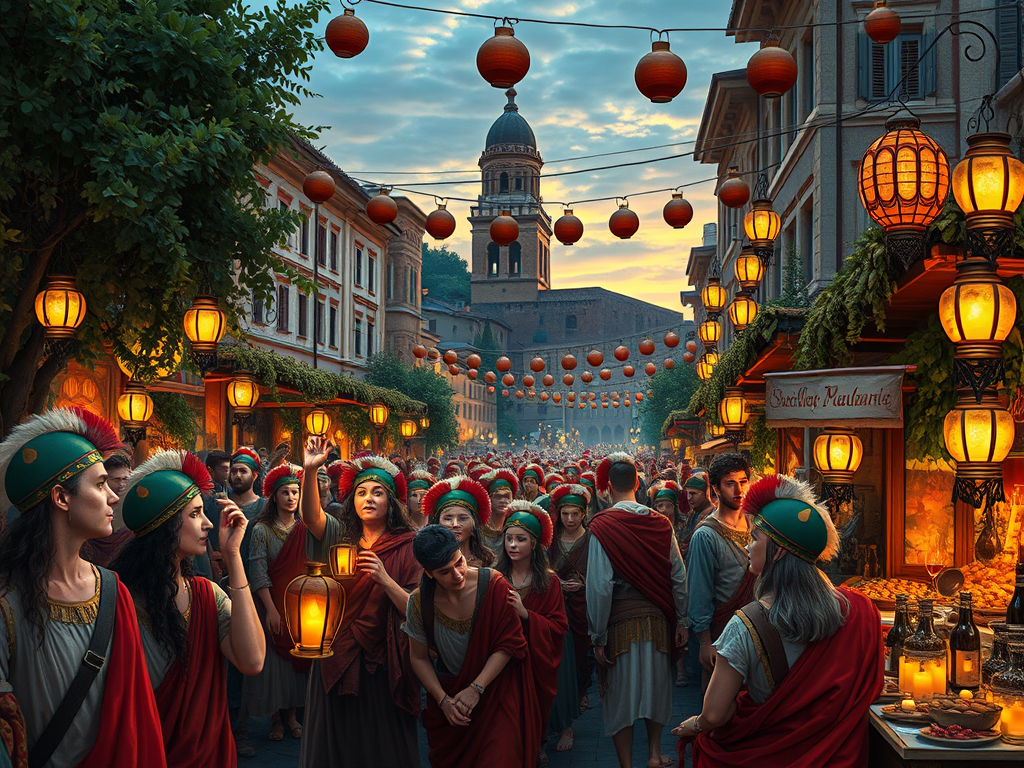
Introduction: Saturnalia—Rome’s Holiday Madness
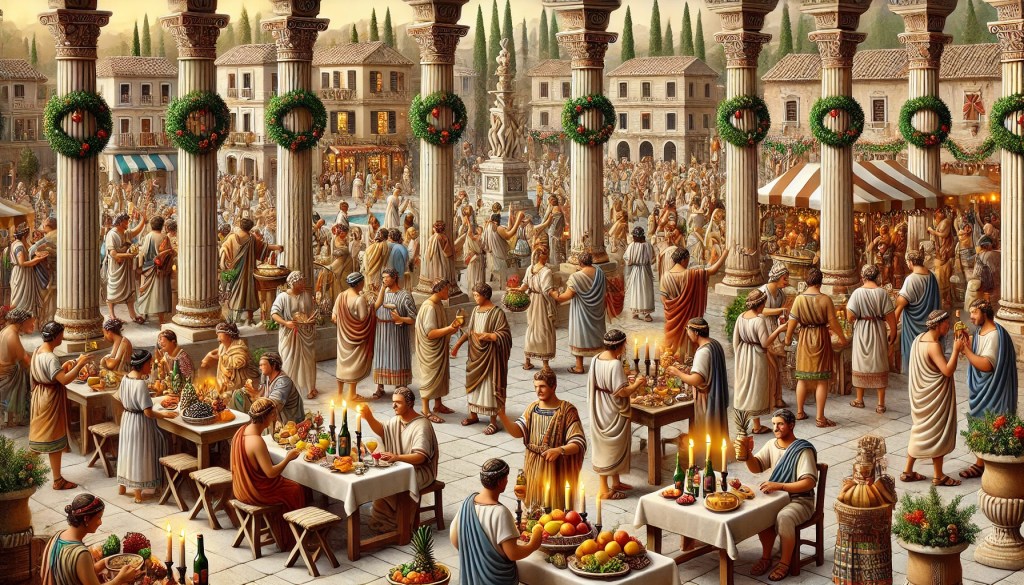
Picture this: It’s December in ancient Rome. Instead of a Christmas tree, you’ve got a wreath of greenery on the door. Instead of George Michael, the streets echo with rowdy singing and off-key flutes. No credit cards, tacky LED light shows or gaming consoles as gifts—just clay lamps, tiny gifts (like wax candles and figurines), and bustling markets overflowing with cheap wine and questionable sweetmeats. It’s Saturnalia, the festival where masters and slaves swap roles for a day, everyone wears a silly cap (the pileus) to signal freedom and equality, and the city collectively loses its mind in a flurry of parties and practical jokes.
Sounds very similiar to our modern Christmas doesn’t it? Two thousand years later, we’re still doing the same dance—overindulging in food and drink, overspending on gifts, and trying not to strangle a relative who “means well” but could drive even a saint insane. The backdrop might have changed, but the script remains eerily familiar.
The big question is: how did the Stoics, those masters of self-control and reason, handle this ancient holiday madness? And can their wisdom help us keep our cool when our modern Christmas turns into complete chaos? I think it can—and I’m about to show you how.
(Internal Link: For more on improving your relationships, see my post on Harnessing Stoicism to Strengthen Modern Relationships)
Stoics Under the Holiday Spotlight: Seneca, Cato, and Epictetus
Seneca’s December Dilemma
Seneca gives us a direct account regarding his experience during Saturnalia and how he deals with the chaos in his Letters to Lucilius. In Letter XVIII, he writes:
“It is the month of December, and yet the whole city is in a sweat! Festivity at state expense is given free rein; a license. Everywhere there echoes the noise of preparations on a massive scale. It all suggests that the Saturnalia holidays are different from the ordinary working day, when the difference in reality is non-existent – so much so that the man who said that December used to be a month but is now a year was, in my opinion, not far off the mark!”
– Seneca, Letters to Lucilius, Letter XVIII
Seneca’s not telling you to skip the holiday entirely—he’s no Grinch in a toga. He’s saying that even though everyone around you might be going nuts with preparations, overspending on gifts or getting sloshed on cheap wine —that doesn’t mean you have to follow suit. The real test of character comes when opportunity for excess is right in your face. If all your neighbors are chugging goblets of spiced mulsum(roman honeywine), Seneca suggests there’s more strength in sipping moderately than getting puking drunk. Keep your bearings, savor rather than shovel, and don’t let the holiday’s loosened moral reins drag you off your path.
Yet Seneca doesn’t recommend locking yourself in your room to read philosophy scrolls while everyone else parties. He acknowledges that you can still partake—just do it on your own terms. The victory lies not in total abstinence, but in celebrating without losing yourself. In other words, bring your own standards to the table instead of surrendering them to the crowd.
Cato’s Iron Will
If Seneca shows us the path, Cato the Younger embodies the ideal. Ancient accounts (like those by Plutarch) tell us Cato never strayed from his principles—not even when everyone else dove headfirst into vice. He ate frugally, dressed simply, and refused to pander to popular excesses. Although no direct written record exists of Cato’s behavior during Saturnalia’s chaos or whether he even partook at all we can assume that most likely he would’ve managed a small smile at the festivities while keeping his plate modest and his mind clear. His example proves that true character shines brightest against a backdrop of indulgence. If everyone else is losing their marbles, staying steady becomes a virtue in itself.
Epictetus: Treat Life Like a Banquet

Epictetus provides the perfect metaphor to carry into the holidays and beyond:
“Remember that you ought to behave in life as you would at a banquet. As something is being passed around it comes to you; stretch out your hand, take a portion of it politely. It passes on; do not detain it. Or it has not come to you yet; do not project your desire to meet it, but wait until it comes in front of you. So act toward children, so toward a wife, so toward office, so toward wealth.”
-Epictetus
The same goes for handling life’s many courses. Whether it’s your aunt’s famous pie or your brother’s unwanted monologue, not everything demands your appetite or your outrage.
This banquet analogy works perfectly for our modern holiday chaos, too. You don’t have to gobble up every treat offered or choke down every slice of Uncle Bob’s unsolicited political hot takes. As Seneca wisely said, “The best cure for anger is delay.” Before biting back, give yourself a moment. Think of it as a lavish feast—of food, opinions, and personalities—where you choose what to savor and what to leave untouched. Your inner calm is too precious to sacrifice, even if that gravy boat of drama drifts your way. Besides, waiting a few seconds before deciding whether to serve up a response can save you from dishing out a side order of regret. Sometimes it’s better to let that spicy comment sit on the buffet table rather than ladling it onto your plate.
(Affiliate Link: Start your next year The Stoic Way by keeping your own very own Daily Stoic Journal)
Conclusion: Different Century, Same Chaos
Two thousand years separate our gift-wrapped existence from the wreath-crowned Saturnalia, but the heart of the problem remains the same: holiday frenzy, peer pressure, overindulgence, and prickly relatives. The Stoics saw it all—and they handled it with finesse. Seneca’s measured approach, Cato’s iron self-control, and Epictetus’s elegant banquet philosophy remind us that we’re never at the mercy of the crowd unless we choose to be.
This holiday season, remember that the setting may have changed, but human nature hasn’t. With the Stoics at your side, you can enjoy the festivities without losing yourself, savoring the season’s sweetness in moderation, kindness, and composure. After all, it’s your holiday too—celebrate like you mean it, not like the drunken mob demands.
Try one Stoic-inspired tip this holiday—maybe Seneca’s advice of not bending to the crowd’s excess or Epictetus’s banquet mindset. Then let me know how it went!
“We suffer more often in imagination than in reality.” — Seneca
But trust me, my hosting bills are very real. If you find these resources and my blog valuable, please consider making a donation. After all, even a Stoic can’t pay for web hosting with virtue alone!

 The Stoic Way - Timeless wisdom for Modern resilience
Leave a comment